


Syllabus: GS3/Science and Technology
Context
- Scientists have found that investors are overestimating the experience rate of nuclear fusion.
About
- The experience rate of nuclear fusion refers to how the cost or efficiency of fusion technology improves with accumulated experience.
- Current nuclear fusion models often assume experience rates between 8% and 20%.
- After examining the unit size, design complexity, and need for customisation, Scientists found that fusion power plants will likely see experience rates of 2% to 8%.
What is Nuclear Fusion?
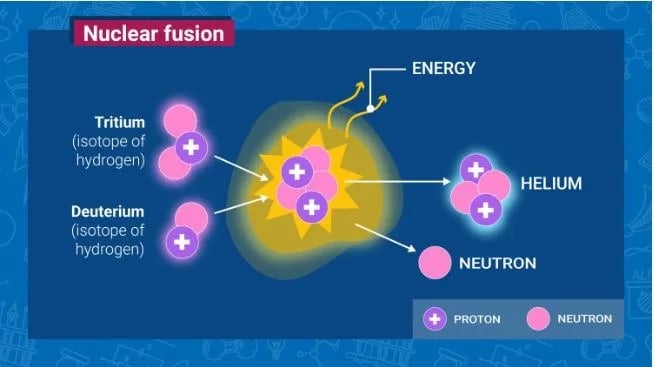
- Nuclear fusion is the process by which two light atomic nuclei combine to form a single heavier one while releasing massive amounts of energy.
- Fusion reactions take place in a state of matter called plasma — a hot, charged gas made of positive ions and free-moving electrons with unique properties distinct from solids, liquids or gases.
- The sun, along with all other stars, is powered by this reaction.
- Process: The Deuterium (H-2) and Tritium (H-3) atoms are combined to form Helium (He-4). A free and fast neutron is also released as a result.
- The neutron is powered by the kinetic energy converted from the ‘extra’ mass left over after the combination of lighter nuclei of deuterium and tritium occurs.
Challenges of Fusion Energy
- Extreme temperature requirement: It needs ~100 million °C to initiate and sustain fusion.
- Plasma instability: Hot plasma is highly unstable and difficult to confine.
- Magnetic confinement complexity: Advanced systems like Tokamak are technically challenging and costly.
- Net energy gain issue: Achieving sustained energy output greater than input is still difficult.
- Material degradation: Reactor walls face intense neutron bombardment and heat damage.
- High cost & long gestation: Projects like ITER require massive funding and decades of development.
Significance of Fusion Energy
- Clean Energy: Nuclear fusion just like fission does not emit carbon dioxide or other greenhouse gases into the atmosphere, so it could be a long-term source of low-carbon electricity from the second half of this century onwards.
- More Efficient: Fusion could generate four times more energy per kilogram of fuel than fission (used in nuclear power plants) and nearly four million times more energy than burning oil or coal.
- Fusion fuel is plentiful and easily accessible: Deuterium can be extracted inexpensively from seawater, and tritium can potentially be produced from the reaction of fusion-generated neutrons with naturally abundant lithium.
- These fuel supplies would last for millions of years.
- Safer to Use: Future fusion reactors are also intrinsically safe and are not expected to produce high activity or long-lived nuclear waste.
- Furthermore, as the fusion process is difficult to start and maintain, there is no risk of a runaway reaction and meltdown.
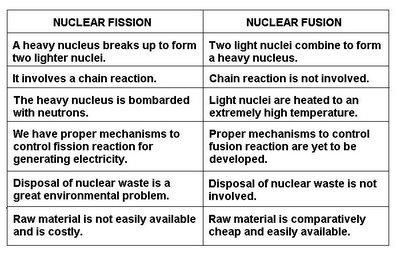
Difference between Nuclear Fusion and Fission
Source: TH
Previous article
Revised Classification of Districts Affected by Left-Wing Extremism
Next article
News In Short 04-04-2026
